
1. A strange market
Order a hundred thousand GPUs today and the delivery quote comes back in months; order the electricity to run them and the quote comes back in years. In several US markets, the wait for grid power now exceeds the useful life of the chips it was meant to serve.
The most valuable machines in the world are obsolete within a few years and arrive by truck; the thing they consume is made by machines that last for generations and arrives by queue and backlog. We have built an economy in which the perishable good is fast and the durable good is slow — in which compute lives on a product schedule while power still lives on an infrastructure schedule.
Compute has solved this exact problem once before. It began as a utility too: a mainframe one shared, a queue one waited in. Then the machine shrank to something a buyer could own, and the queue ceased to matter. Power is the last input to compute still sold the old way.
2. The demand line
Begin with what the buyers say, since they publish it.
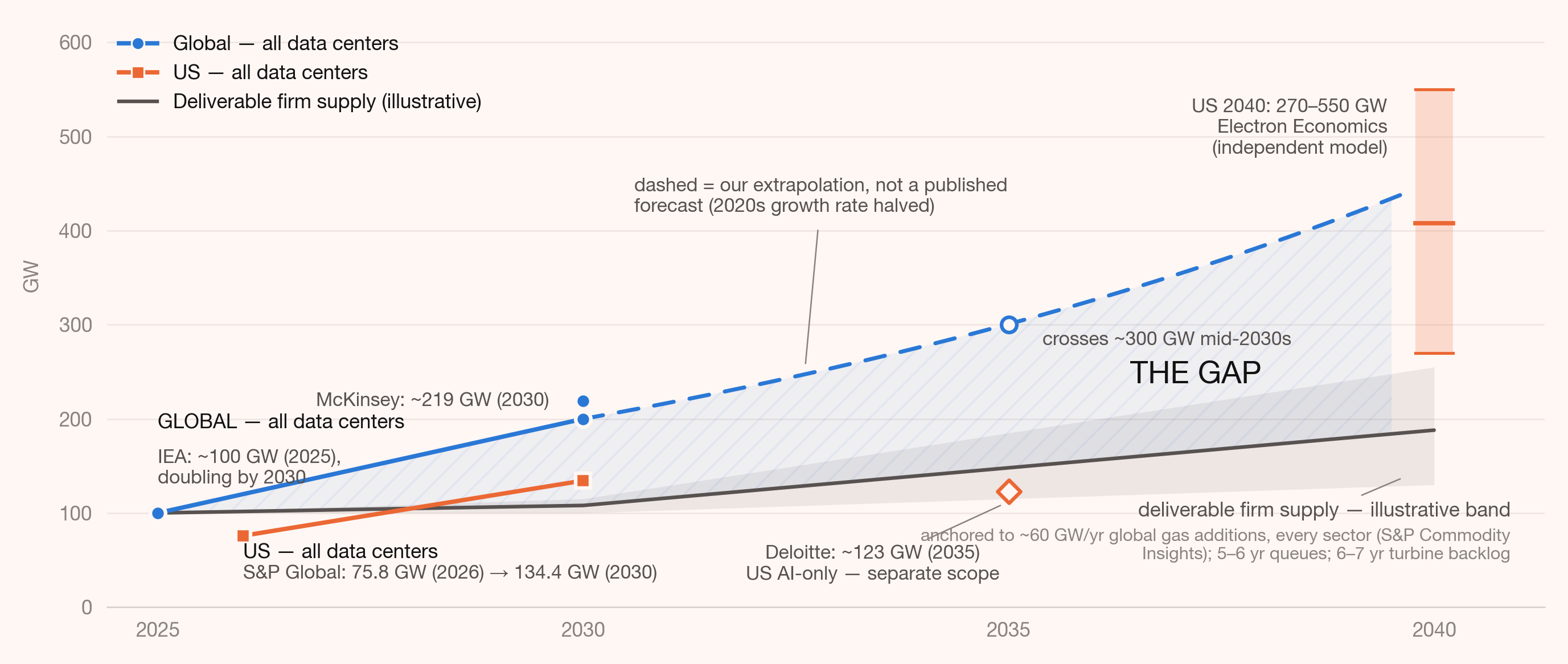
Global data centers operate roughly 100 GW of capacity today; the IEA projects that figure to double by 2030, with about 945 TWh of consumption. The AI slice is the steep part of the curve: about 30 GW in 2025, headed to 90+ GW by 2030 (Goldman Sachs, IEA), growing at around 22% a year. S&P Global has US data-center demand at 75.8 GW in 2026 and 134.4 GW in 2030; Deloitte has US AI data centers alone reaching up to ~123 GW by 2035, from ~4 GW in 2024. Carried further, McKinsey (2025) has global capacity roughly tripling to ~219 GW by 2030, and the IEA has consumption at ~1,300 TWh by 2035. Continued at even half the growth rate of the 2020s, those trajectories cross 300 GW worldwide in the mid-2030s — that is our extrapolation, not anyone’s published forecast. The one model published to 2040 brackets US capacity at 270–550 GW (Electron Economics, 2025, independent). But the far end of the curve is not required; the 2030 numbers are already unserviceable.
These forecasts will be wrong in detail. If models improve, demand grows, because useful intelligence gets cheaper; if models plateau, the market spends more compute in search of the next improvement. Cheaper inference creates more inference.
The near-term subtraction is elementary: 134.4 minus 75.8 is roughly 59 GW of new US data-center demand in four years — call it 15 GW a year, in one country, for one industry.
Two features of this demand matter as much as its size. It is concentrated: the US accounts for nearly half of global growth through 2030 (IEA), and hyperscalers hold about 70% of US capacity (Goldman Sachs), so the buyers are few, sophisticated, and able to sign very large checks. And it is impatient, for a structural reason. Inference and general intelligence is the most important market in the world at present, and nearly every venture portfolio is a bet on compute continuing to ramp; when revenue is bounded by the wattage one can energize, power becomes the income statement. Demand of this shape does not wait politely for the grid.
3. The supply wall
The other side of the ledger is public record throughout.
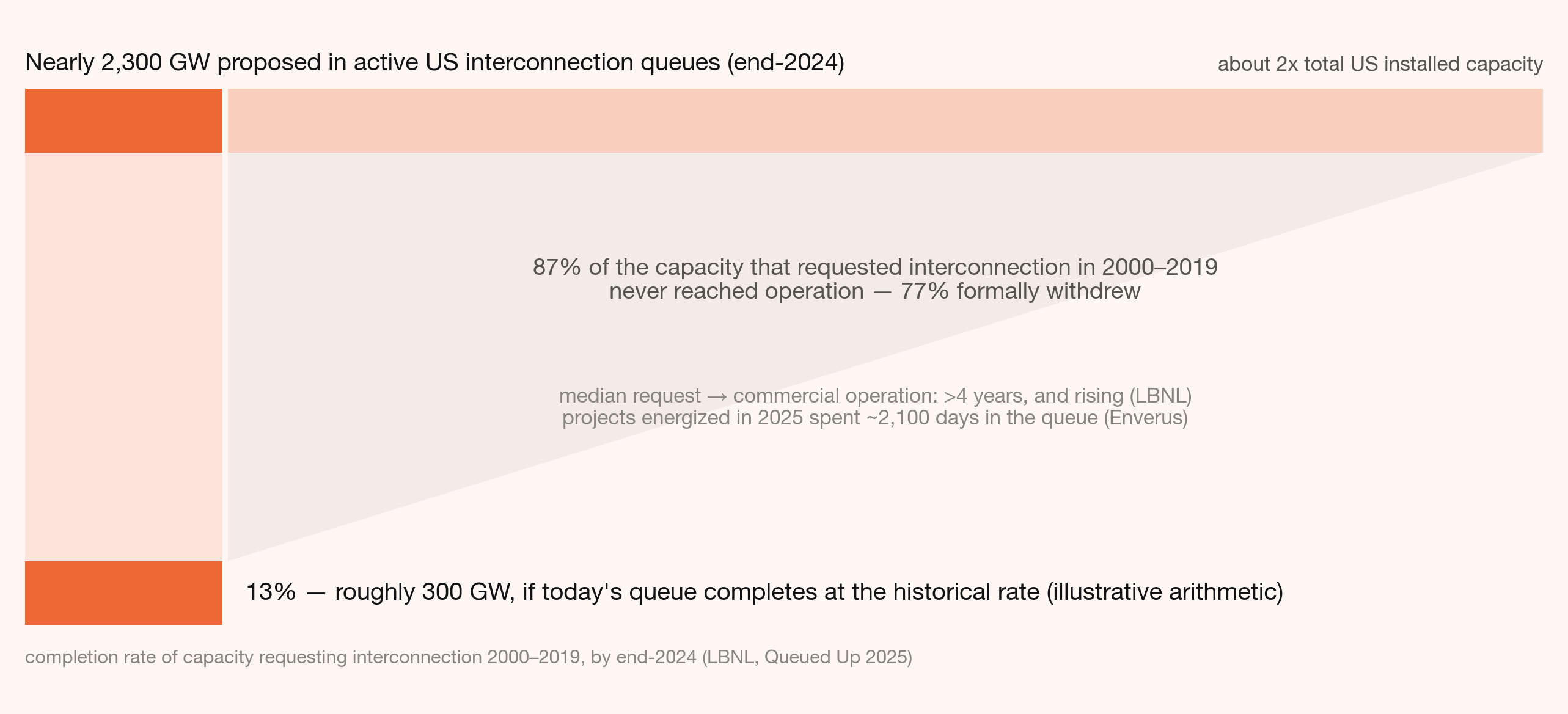
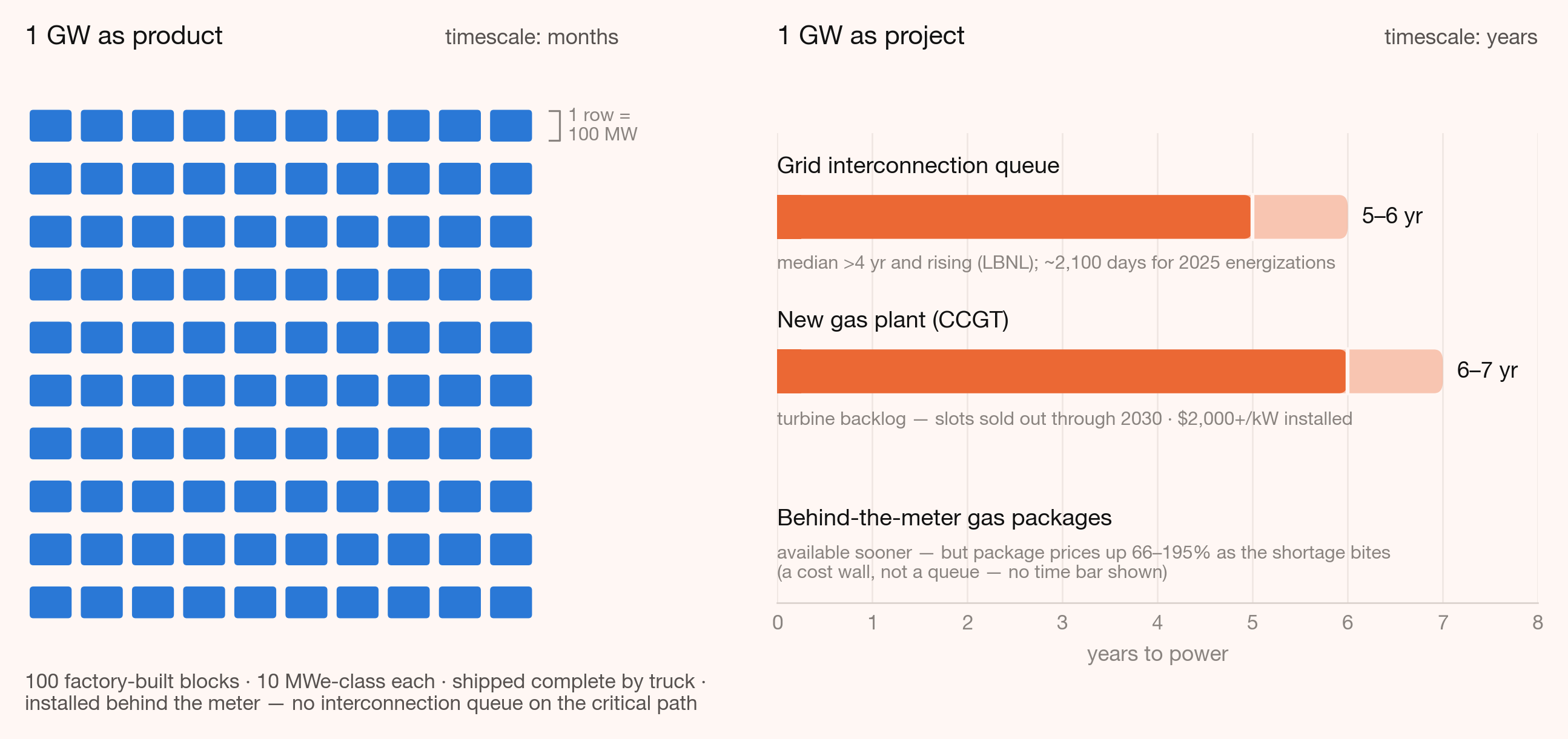
The grid. Nearly 2,300 GW of proposed generation and storage sat in US interconnection queues at the end of 2024 — approaching twice the country’s installed capacity (LBNL, 2025). Projects energized in 2025 took about 2,100 days from request to operation (Enverus), and only 13% of the capacity requesting interconnection from 2000 to 2019 ever reached operation (LBNL, 2025). The queue is a filter that consumes half a decade. Arrivals keep accelerating regardless: ERCOT alone counted over 438 GW of proposed large-load requests by mid-2026, mostly data centers — five times its 85.5 GW record peak (ERCOT, 2026).
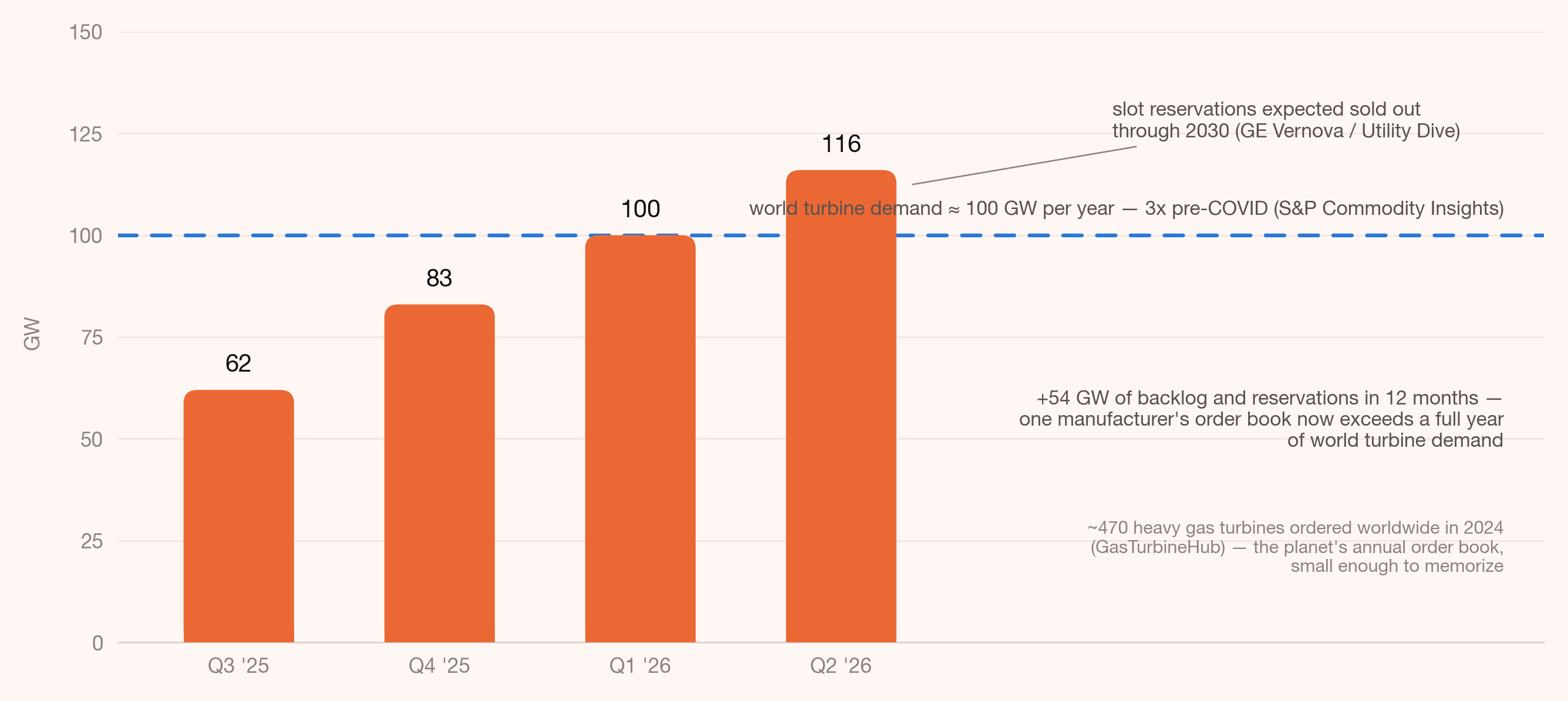
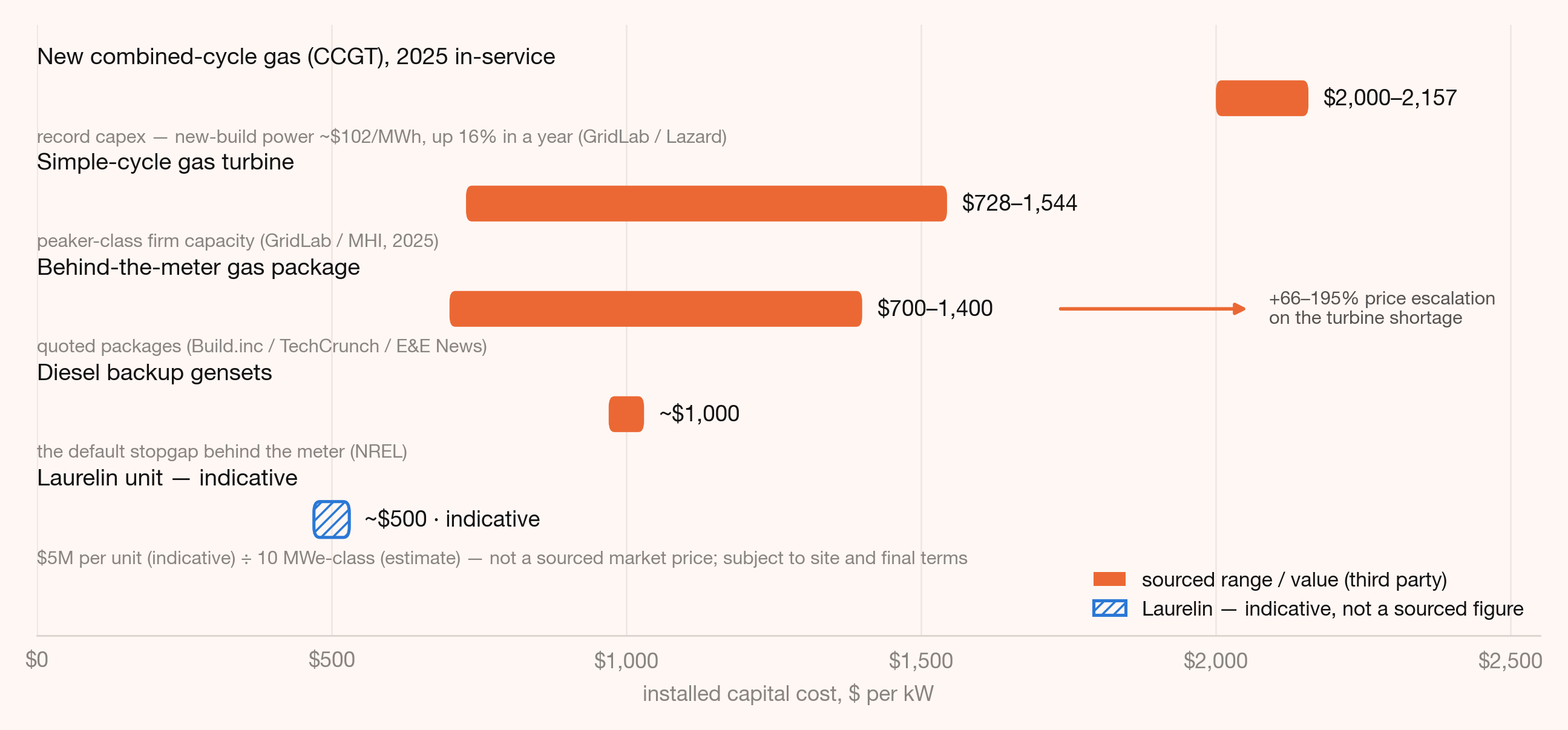
Gas turbines. The world’s workhorse for firm power is a genuinely great machine, and the industry ordered roughly 470 of them worldwide in 2024 (GasTurbineHub) — the whole planet’s annual order book, small enough to memorize. Turbine demand runs near 100 GW a year, roughly triple pre-COVID levels (S&P Global Commodity Insights, 2026); GE Vernova’s gas backlog and slot reservations alone reached 116 GW in mid-2026, with slots expected to be sold out through 2030 and delivery horizons of six to seven years (GE Vernova earnings, 2026; Utility Dive). Planned gas additions worldwide run to about 890 GW across 2025–2040 — call it 60 GW a year, for everything, everywhere. Set that against 15 GW a year from US data centers alone, before anyone else’s electrification is counted, and the ledger does not close. A technology can be mature and still be unavailable, and prices concur: combined-cycle plants entering service in 2025 cost $2,000–$2,157/kW, new-build power around $102/MWh — a record, up 16% in a year (GridLab, Lazard) — and behind-the-meter gas packages have escalated 66–195% as the shortage bites.
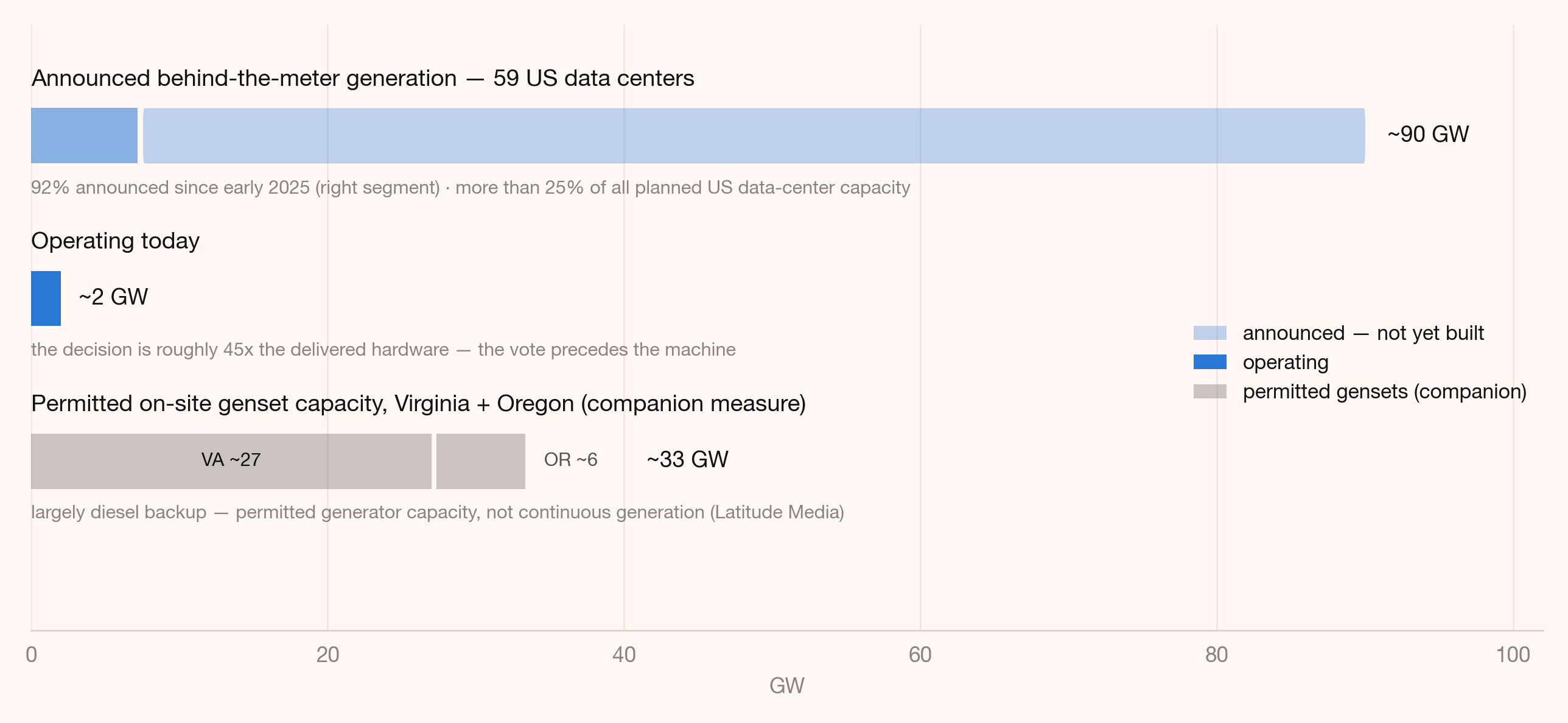
The tell. Virginia has permitted roughly 27 GW of behind-the-meter generator capacity for data centers; Oregon another ~6 GW (Latitude Media). Most of it is diesel backup at about $1,000/kW. When the most sophisticated infrastructure buyers on Earth permit tens of gigawatts of diesel, the shelves are empty — and the same permits disclose where power is going. Cleanview counts about 90 GW of announced behind-the-meter generation across US data centers — more than a quarter of all planned capacity, nearly all of it announced since early 2025. The buyers have stopped waiting for the shared system to grow and are moving generation to their own side of the meter, where they control it. The market has already decided that power should be decentralized; it has yet to find the right machine to do it with.
Solar and storage. At ~$25/MWh, solar is the cheapest electricity humans have ever made, and it should be built as fast as glass can be poured. But a data center is a 24/7 load with contractual uptime, and solar-plus-batteries firm enough for that duty cycle is a different and harder product. Solar wins the energy; the contest here is over firmness.
None of these options is a mistake. All of it gets built, and the wedge in Figure 1 persists anyway. This is energy addition, not energy transition, and the gap lives precisely where a new kind of supply would have to appear.
4. What the buyers have already decided
The strongest evidence about the future of firm power is a signature.
Switch has contracted with Oklo for 12 GW of its Aurora fission powerhouses through 2044. Amazon is backing 5 GW of X-energy small modular reactors and bought 1,920 MW of existing nuclear from Talen for $18 billion over 17 years. Google signed Kairos Power for a 500 MW molten-salt fleet by 2035; Equinix signed Oklo for 500 MW of PPAs. Microsoft signed a 50 MW fusion power purchase agreement with Helion — financial penalties attached — targeted for 2029. The SMR order book went from near zero in 2023 to ~22 GW in development, with over $10 billion committed. Sophisticated buyers do not pre-purchase the output of unbuilt first-of-a-kind plants while conventional supply is available on reasonable terms; the forward contracts are the demand curve stating, in dollars, that the supply curve is broken.
The field deserves to be taken seriously. Commonwealth Fusion Systems built record-class high-temperature superconducting magnets and published its plant physics in peer-reviewed papers; that is how trust is earned. Helion accepted contractual penalties on a delivery date — the opposite of hype — even as that date has moved from 2028 to 2029. Oklo, X-energy, and Kairos are doing the unglamorous licensing work that makes nuclear real.
But attend to the shape of what each mainline path asks its backers to believe. A conventional D-T fusion plant needs plant-scale construction to pencil, and a tritium-breeding blanket that works (tritium is not mined; the plant must make its own fuel), and materials that survive years of bombardment by the fast neutrons carrying about 80% of the fusion energy, and a steam cycle converting heat to electricity at roughly 33% efficiency. Other advanced approaches substitute conjunctions of their own: exotic fuel supplies, first-of-a-kind licensing, decade-scale civil works.
Every clause in these chains is credible on its own; the cruelty is in the AND. Four beliefs, each individually reasonable, multiply into a small joint probability, and the test of the whole conjunction arrives at the end, after the most expensive step. Conjunctive risk does this to any plan of that shape, whoever runs it — and it is exactly the trap our own program is built to avoid.
5. The phase map
The market’s behavior has a legible shape: it moves in phases.
Phase 1: buy power that exists. Contract plants already running; interconnect where the grid has slack. Amazon-Talen is the cleanest example — billions for megawatts already there. The inventory is finite, and it is mostly claimed.
Phase 2: build power on-site. Behind-the-meter gas, diesel fleets, solar hybrids. The 33 GW of genset permits in two states is Phase 2 in full swing. It works, at escalating prices, until the turbine and transformer order books cap it — and the cap is already visible in the current numbers.
Phase 3: manufacture power. When site-built supply saturates, firm generation must become what this industry has already made servers become: a factory product, built on a line, shipped in a standard envelope, installed behind the meter in weeks, improved on a manufacturing learning curve rather than a construction schedule. There is a name for this shape. Computing ran it, from the shared mainframe to the PC to the racks in these data centers; telephony ran it, from the wired network to the phone in one’s pocket, and mobile lines passed fixed lines worldwide in 2002 without ever looking back. When a technology moves from shared infrastructure to owned units, the learning curve takes over and the queue ceases to be part of the product. Grid power has yet to make that move. Phase 3 is that move, and the 22 GW SMR order book is the market ordering Phase 3 hardware in advance of its existence.
What the winning Phase 3 machine looks like can be derived from the constraints rather than from technological preference. Factory-built, with no site construction on the critical path. Fuel-unconstrained: no pipeline, no enrichment queue, no exotic isotope logistics. Behind the meter and owned by the buyer, so that the queue is irrelevant and the power sits under the same roof as the load it serves. Blocks of around ten megawatts — large enough to matter, small enough to stack, truck, and finance. Priced to undercut the $2,000/kW gas plant decisively.
Phase 3 arrives regardless of anything Laurelin does; the contracts above are the receipts. The market has arrived before the product — a rare ordering, and one that rewards whoever moves first. The open question is what the machine is, and who ships it.
6. One number
Laurelin exists because we believe a compact deuterium machine is the shortest engineering line to that specification. Our first machine, RDG-01-FRC, carries the working name Anar: in the mythology from which our company takes its name, the Sun — kindled from the fruit of Laurelin, the golden tree, the first light the world received. It is a symmetric linear pulsed field-reversed configuration, designed so that the question “does this reach net energy?” collapses from a stack of beliefs into one measurable number.
Integration is the honest engineering challenge: many subsystems must work as one machine. But none of them asks for new science. The hardware that recovers electricity from each pulse descends from pulsed-power systems industry has operated for decades, and the containment hardware from high-temperature methods that already exist. What is new is the assembly, not the parts.
Our machine fires energy into a pulse of fusion fuel, recovers most of that energy directly as electricity, and keeps the surplus the fusion reaction adds. There is no steam and no turbine hall, and the entire design question collapses to a single figure: the fraction of each pulse’s energy the circuit gets back. Industrial pulsed-power systems already operate in the efficiency range we require, and the number can be verified at full performance for a small fraction of the program’s budget, before any reactor exists. The specific targets remain in-house; competitors read manifestos too.
That is the whole trade. Other paths ask their backers to believe four hard things whose joint test comes last; this one asks them to believe one number whose test comes first. The physics behind that claim, with every symbol defined, is in Appendix A.
The fuel is part of the same discipline. Deuterium comes from seawater at about $13 per gram: no breeding blanket, no strategic isotope supply chain. D-D is not tritium-free — one branch produces tritium, which is managed and consumed in the machine rather than bred as a survival requirement — but only about 34% of its fusion energy leaves as neutrons, at 2.45 MeV, against about 80% for D-T at far higher energies. Softer neutrons mean lighter shielding, and a materials problem measured in engineering margins rather than research programs; that is what permits the machine to live in a 40-foot-container-class envelope instead of a building.
Compactness also purchases iteration speed: a machine that fits in a container is a machine whose next version one can afford to build. The physics cares only how many times you get to be wrong before you are right.
The container is the business model. A 10 MWe-class unit (our sizing estimate, between a gas package and an SMR block) at an indicative $5M works out to roughly $500/kW: the five-hundred-dollar kilowatt, about one quarter the capex of a new combined-cycle plant, without the turbine queue, and verifiable with a single division. The arithmetic scales without strain: a 100 MW AI campus is ten containers on a pad, indicatively $50M of hardware; a gigawatt is a hundred units, about $500M indicative, against $2B+ of CCGT — if the turbines could be had at all.
Small units are the point. A single plant is one interconnection, one construction schedule, and one point of failure; a hundred-unit fleet is none of those things. The campus that runs on ten containers can lose one and keep ninety percent of its power, add an eleventh when the racks grow, and take delivery of the first while a plant would still be in permitting. Decentralized firm power is a different product from the plant it replaces, and it is the one the queue and the order books have been pricing all along. In the market for megawatt hours, every generator ever built competes on price; we are entering the market for delivered firm capacity, where today there is no product on the shelf at all.
No one — not us, not anyone in fusion — has demonstrated net electricity, and we have not built this machine. What we have built is a program in which the machine is not permitted to exist until the number that justifies it has been measured.
7. The use case: who pays
The first customer is an AI data center with money, land, and racks, held behind a five-year queue or a sold-out turbine book. They buy firm power as hardware, delivered behind the meter, with no interconnection on the critical path. Their alternative for the same ten megawatts is a $20M+ gas block they cannot take delivery of before the end of the decade; ours is a container on a pad.
The money works like enterprise hardware rather than a utility: an indicative $5M per unit up front, then roughly $650K a year per unit, at indicative prices, in liner cartridges, service, deuterium, and control software. Over a fifteen-year life the recurring stream comes to about twice the original hardware sale, so a hundred-unit campus is a half-billion-dollar order that keeps paying.
We sell the box, or the power under contract where the site prefers it; the wedge is the box. On our arithmetic, the addressable market is roughly $50 billion a year of hardware at our price point — around ten thousand units a year — before the premium segments: defense and remote sites pay $6.5–8M indicative per unit, because their alternative is diesel at a fully burdened $10–40+ a gallon delivered.
And the cost curve runs downhill from there: each unit off the line is cheaper than the last, as manufactured products are and constructed projects are not. That is the shape investors recognize from every hardware business that has worked — margin expanding with volume, recurring revenue compounding on an installed base.
8. The plan, briefly
We run this program the way disciplined hardware companies run product development: retire the most expensive risk first, and commit capital against answers rather than hopes.
Milestone one, targeted at month ten, qualifies the machine’s make-or-break subsystem — the energy-recovery electronics — at full performance, before serious capital goes into the machine around it: the engine qualified before the car is built. It is a hard go/no-go. Pass, and the rest of the program is engineering execution on a de-risked design; fail, and we stop, having spent a small fraction of the budget to obtain the answer that matters. No one else in the field structures the question to be answered this early or this cheaply.
Targeted at month fourteen, the first machine switches on. Targeted at month 36, a net-energy demonstration. The commercial product phase begins in year five and beyond, and it looks like manufacturing rather than construction. Each milestone is priced to be the cheapest possible purchase of the information that justifies the next, and the public demonstration is what converts the offtake appetite of section four into orders for hardware that exists. We will finance a sequence of answers rather than a decade of belief.
Can manufacturing matter at gigawatt scale? Shipped power products have done it before. Tesla went from 2,650 cars delivered in 2012 to 50,580 in 2015 — nineteenfold in three years, per its SEC filings — because cars come off lines. Bloom Energy went from 200 fuel-cell servers in 2011 to roughly 2 GW of annual production capacity by 2026. Factories compound in a way construction sites do not, and a firm-power source that ships like a server belongs to a different industrial species from one poured in place.
9. The sum
Demand: tens of gigawatts a year, published by the buyers themselves, crossing 300 GW worldwide in the mid-2030s even if growth halves (our extrapolation). Supply: a queue that consumes half a decade, a turbine industry booked years ahead, diesel permits standing in for strategy. Revealed preference: gigawatts of signed offtake for unbuilt hardware. Every existing option gets built flat-out, and the wedge persists.
Someone closes that wedge. The physics of pulsed recovery is public; the container arithmetic takes one division; the offtake appetite is on the record. Firm power will be manufactured as a product — factory-built, fuel-unconstrained, sited behind the meter, priced in hundreds of dollars per kilowatt — because every force counted above pushes toward that outcome and nothing pushes back except habit. Decentralization here is arithmetic rather than ideology: compute decentralized when the owned machine beat the shared one on cost and delivery, and power crosses the same line the day a factory-built unit undercuts the constructed plant. Every number above says the line is close. This will happen; the only question is who — which fuel cycle, whose factory, which country. We have placed our bet on deuterium, on ourselves, and on the United States.
Fuel deserves the same audit as turbines, and it returns the same verdict. Every firm-power source one can buy has a supply chain that passes through someone else’s territory or someone else’s navy: gas moves through pipelines and LNG terminals that can be closed; uranium moves through enrichment queues governed by treaty; solar hardware ships from a handful of coastal provinces. Oil is the extreme case, and in March 2026 it ceased to be a modeling exercise — the Strait of Hormuz was mined, roughly 10.5 million barrels a day of Gulf production was shut in by April, and Brent touched $126. Deuterium’s supply chain is seawater: one atom in 6,400 of the ocean’s hydrogen, about $13 a gram, from any coastline, guarded by no one. There is no queue to stand in, no pipeline to permit, no treaty to honor, no strait to patrol; a machine fueled from seawater and sited behind the meter runs without asking anyone’s permission. A fuel choice is a security decision wearing a chemistry costume. The full argument is in our whitepaper, The petrodollar architecture, deuterium fusion, and the case for direct-conversion compact pulsed FRC.
The bet is structured so that the world gets its answer early: month ten produces a number.
10. Coda
Laurelin exists to make firm power a product you order rather than a project you endure. The near-term work is unglamorous on purpose: qualify the one subsystem on which everything else depends, and then let the machine earn its existence. Machines of this kind are built with partners who think in decades.
If you are the kind of engineer who checked our arithmetic before finishing this essay — pulsed power, plasma, or production lines — we are hiring, at laurelin-inc.com.
Compute became something you own. Power is next. The chips arrive in months; soon, so will the power.
References
Appendix A: The physics, briefly
This appendix is for the reader who was forwarded the essay and wants to know whether the physics holds up. Everything below is textbook or published-literature physics; none of it depends on a proprietary number.
The fuel. Deuterium is hydrogen with one extra neutron. About one atom in 6,400 of the hydrogen in seawater is deuterium, which makes it the only fusion fuel you can buy as a commodity forever. Two deuterium nuclei fuse through two branches of roughly equal probability:
(An MeV, or mega-electron-volt, is the standard unit of nuclear reaction energy; T is tritium, ³He is helium-3, p a proton, n a neutron.) The prompt neutron carries 2.45 out of the ~7.3 MeV released per reaction pair, so about 34% of D-D fusion energy leaves as neutrons. Compare deuterium-tritium fuel, where a single 14.1 MeV neutron carries roughly 80% of the yield. Fewer, softer neutrons mean the wall-materials and shielding problem shrinks from a research program to an engineering margin, which is what lets the machine live in a container instead of a building.
Two honest qualifications. First, D-D is not tritium-free: the first branch produces tritium, and tritium left to burn in the plasma yields 14.1 MeV neutrons of its own. We treat that tritium as a managed inventory, captured and accounted for inside the machine, rather than as a fuel the plant must breed to survive. Second, D-D is the harder reaction: at a given temperature its reactivity is roughly a hundredfold below D-T (the standard Bosch-Hale tables). In a steady-state plant that penalty is brutal. The rest of this appendix is the answer to it.
The machine class. A field-reversed configuration (FRC) is a self-organized plasma ring that carries its own confining current. Its figure of merit is beta, the ratio of plasma pressure to the pressure of the confining magnetic field. FRC theory and five decades of experiments (Tuszewski’s and Steinhauer’s reviews) put measured FRCs at beta around 0.75 to 0.8; tokamaks operate near 0.05 to 0.1. An order of magnitude more plasma pressure per unit of magnetic field means an order of magnitude smaller machine at the same field. That is the compactness argument, and it is a property of the configuration, not a projection.
Pulsed operation is the second half. Instead of sustaining a burning plasma continuously, a pulsed machine forms an FRC, compresses it magnetically so it fuses for microseconds, recovers the energy electromagnetically at the machine’s terminals, and repeats. Fusion stops being a sustainment problem and becomes a per-pulse energy ledger, with every entry measurable at an electrical boundary on every shot rather than inferred from plasma diagnostics.
The ledger. Per pulse, the machine is net-positive when
where is the electrical energy banked to drive the pulse, is the fraction of that energy recovered back as electricity after the pulse, is the fusion energy released, and covers everything parasitic. The inequality reads as a ledger: the plasma has only to repay the fraction of the drive energy that the circuit fails to catch, and every point of recovery efficiency directly shrinks the fusion yield required. This is where the hundredfold D-D penalty gets paid — the burden shifts onto , a circuit-engineering quantity, in a band where industrial pulsed-power systems already operate, rather than onto heroic plasma performance. We publish no target values for or for gain; the point here is the structure of the inequality, not our position in it.
Why month 10 settles it. is a property of the recovery circuit, not of the plasma. It can therefore be built and measured at full electrical fidelity on a bench, with no plasma and no reactor. That measurement is the program’s first gate, targeted at month 10, and it is a genuine go/no-go: if the recovered fraction is in the band the ledger requires, net energy becomes an engineering execution problem; if it is not, we stop, having spent bench-scale money to learn a reactor-scale truth. Most fusion paths test their load-bearing assumption after the most expensive step. This one tests it first.
What remains proprietary is how our machine achieves its numbers. That stays off the page, here and everywhere.